Bay Harbor Islands, Florida
 info@upideas.us
 (305) 572-5670

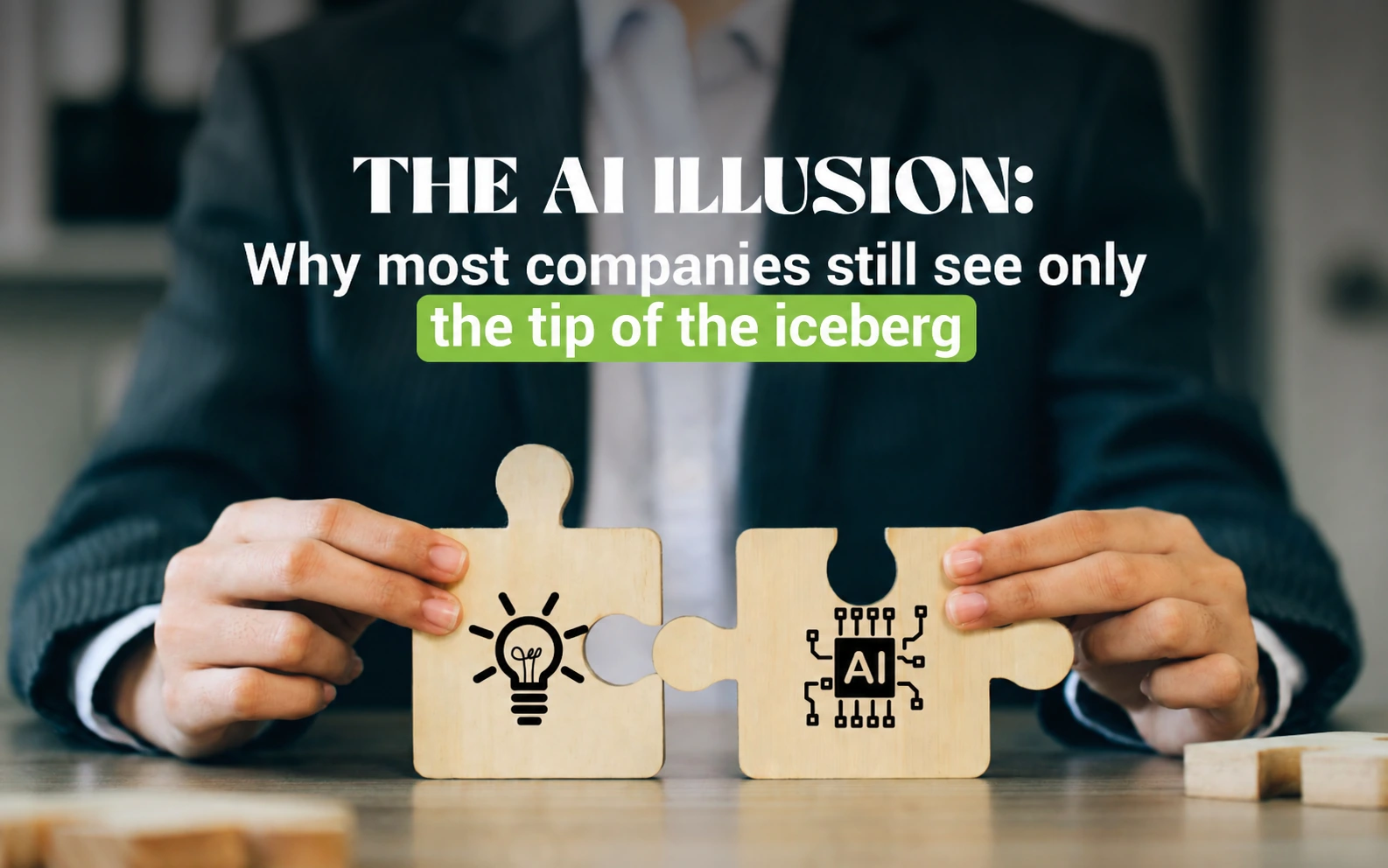
Why Are Most Companies Still Only Seeing the Tip of the Iceberg?
Over the past two years, Artificial Intelligence has shifted from an exclusive technology reserved for tech giants into an accessible toolkit for virtually any business. Today, platforms available to every organization allow us to generate content, design images, produce videos, analyze datasets, and automate workflows.
This democratization has fundamentally transformed how companies operate. However, it has also created a dangerous misconception: the belief that simply adopting AI tools is enough to transform a business.
The reality proves otherwise.
According to the Writer Enterprise AI Adoption Report 2026, while Generative AI adoption has accelerated rapidly, only 29% of enterprises report seeing a significant return on their investment. The technology is available to everyone, yet meaningful results remain out of reach for most.
The question is no longer whether a company uses Artificial Intelligence.
The real question is whether it is being used to execute isolated tasks or as part of an integrated system engineered for growth.
The Tip of the Iceberg: When AI Is Treated Merely as a Tool
Most organizations have begun using AI to solve specific, highly tactical needs: drafting content, creating social media graphics, producing videos, answering FAQs, or automating basic administrative tasks.
All of these applications hold real value. They reduce operational bottlenecks, increase baseline productivity, and free up team members to focus on higher-level strategy.
However, when AI is restricted to executing single, disconnected tasks, its business impact remains strictly limited.
- Creating better posts does not guarantee attracting higher-value clients.
- Responding faster does not automatically boost conversion rates.
- Automating a single process does not inherently drive more revenue.
Artificial Intelligence can make a company more efficient—but efficiency alone does not generate growth without an overarching strategy connecting those efforts toward a singular goal.
That is precisely the most common mistake we see in the market.
Many organizations are superimposing AI tools on top of legacy strategies that remain completely fragmented.
The True Power of AI Unlocks When It Stops Working in Silos
Consider a simple scenario: A company invests in Google Ads and Meta Ads to acquire leads. Users visit the website; some download a catalog, others request a quote, and many abandon the funnel altogether.
In a traditional model, each of these actions occurs independently. The campaign drives clicks, the website logs visits, the form collects contacts, and the sales team follows up whenever bandwidth permits.
Data exists across every step, but it remains completely scattered.
Now imagine that exact same scenario built upon a connected marketing infrastructure.
Every user touchpoint immediately generates actionable intelligence. The AI identifies behavioral patterns, scores high-intent visitors, dynamically adapts communication based on demonstrated interest, and continuously optimizes future campaigns using real-world data rather than assumptions.
The difference isn’t that the company uses Artificial Intelligence—the difference is that AI is embedded within a system that learns continuously. That is where real, scalable growth begins.
Marketing Is No Longer a Collection of Independent Tactics
For decades, digital marketing was built around isolated channels.
There was a strategy for social media, another for paid ads, another for email marketing, and another for the website—each with different owners, metrics, and objectives.
That model worked for a long time. Today, it is obsolete.
The modern buyer journey is far more complex than it was just a few years ago. A prospect might discover your brand through an Instagram ad, research reviews on Google, visit your website multiple times, abandon a contact form, receive an email days later, and ultimately convert through a retargeting campaign.
Every single touchpoint influences the final decision.
If your data remains trapped in platform silos, you lose the ability to understand what’s working, what needs optimization, and how to improve customer experience.
When data becomes connected, marketing stops being reactive and starts learning.
That is the paradigm shift driven by AI: it doesn’t replace strategy—it makes strategy exponentially smarter.
The True Competitive Advantage Is No Longer the Tool
Historically, accessing proprietary technology provided an instant competitive edge.
That is no longer the case.
The exact same AI tools are accessible to virtually every business. The differentiator is no longer who has access to the technology, but who knows how to integrate it into a cohesive growth framework.
McKinsey & Company’s The State of AI report reveals that organizations deriving the highest value from Artificial Intelligence are those integrating it directly into core business operations—redesigning how they make decisions, operate, and deliver value. It’s not about deploying more tools; it’s about engineering processes where technology reinforces every stage of the business.
Salesforce identified this exact trend in their State of Marketing report, emphasizing that high-performing organizations use AI to deepen personalization, sharpen decision-making, and unify customer data, rather than limiting it to task automation.
In short: using Artificial Intelligence is no longer a competitive advantage.
Building an ecosystem where AI drives continuous learning is.
What We Do Differently at Up Ideas Agency
At Up Ideas Agency, we don’t view AI as a standalone service or a trending feature to check off a list.
We treat it as a core capability that amplifies your entire marketing strategy. That’s why our work never starts with tool implementation—it starts by analyzing how your business grows.
We map your customer journey, pinpoint revenue leaks, connect fragmented tech stacks, and build growth systems where every customer interaction informs and improves the next.
We integrate digital advertising, marketing automation, CRM infrastructure, analytics, content, and conversion rate optimization (CRO) so Artificial Intelligence can act upon an entire ecosystem, not isolated tactics.
This allows us to launch campaigns that don’t just deliver immediate metrics—they continuously learn from real user behavior to improve ROI over time.
Our goal isn’t to use AI because it’s trending. Our goal is to make every dollar you spend smarter than the last.
That is the core philosophy behind Under the Surface.
While most companies stay focused on using AI for surface-level execution, we operate where true enterprise value is built: underlying strategy, unified data, deep automation, continuous optimization, and converting insights into sustainable growth.
Real AI Potential Begins Below the Surface
In the coming years, virtually every organization will be using Artificial Intelligence.
The technology itself will cease to be a differentiator. The market leaders will be those capable of building connected systems where strategy, data, and execution operate as a single, self-optimizing ecosystem.
At Up Ideas Agency, that is precisely where we operate.
Under the Surface.
Because sustainable scaling doesn’t depend on a single tool—it depends on an intelligent system designed to learn, evolve, and optimize continuously.
If you’re ready to scale your sales and maximize the yield of your digital assets, let’s talk.
The true power of Artificial Intelligence begins where the surface ends.
References:
- Writer. (2026). Enterprise AI Adoption Report 2026. https://writer.com/reports/enterprise-ai-adoption-report-2026/
- McKinsey & Company. (2025). The State of AI: How organizations are rewiring to capture value. https://www.mckinsey.com/capabilities/quantumblack/our-insights/the-state-of-ai
- Salesforce. (2025). State of Marketing Report. https://www.salesforce.com/resources/research-reports/state-of-marketing/
- Gartner. (2025). Top Strategic Technology Trends y estudios sobre Customer Data Platforms, Personalization y AI in Marketing. https://www.gartner.com/
- HubSpot. (2025). The State of AI in Marketing. https://www.hubspot.com/state-of-ai
- PwC. (2024). Value in Motion: How AI is Reshaping Business. https://www.pwc.com/
- Deloitte. (2025). State of Generative AI in the Enterprise. https://www2.deloitte.com/